
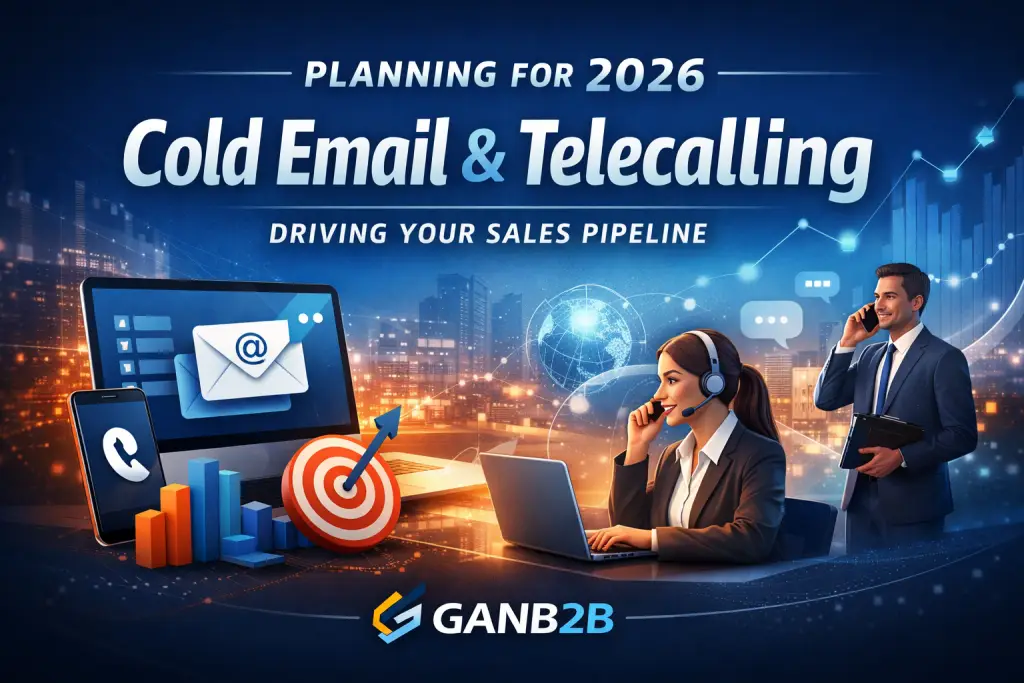
B2B Lead Generation in 2026: How to Plan Cold Email & Telecalling to Build a Strong Sales Pipeline
As we step into 2026, B2B buying behavior continues to evolve—but two channels remain consistently powerful when planned correctly: cold email and telecalling. When aligned with data, personalization, and compliance, these outbound strategies can become a predictable engine for sales pipeline growth.
This blog outlines a practical, 2026-ready framework to plan, execute, and optimize cold email and telecalling campaigns that actually convert.
Why Cold Email & Telecalling Still Matter in 2026
Despite the rise of AI, intent platforms, and inbound marketing, outbound lead generation remains critical for:
- Reaching decision-makers not actively searching
- Launching new products or entering new markets
- Controlling pipeline velocity and forecast accuracy
- Supporting account-based marketing (ABM) strategies
The difference in 2026 is how these channels are executed—quality over volume, relevance over reach.
Step 1: Define Clear Pipeline Goals for 2026
Before launching any outreach, align sales and marketing on measurable outcomes:
- Target pipeline value (e.g., $5M influenced pipeline)
- Number of SQLs / opportunities required
- Ideal deal size and sales cycle length
- Regions and industries to prioritize
This clarity helps reverse-calculate how many conversations, meetings, and leads your cold email and telecalling efforts need to generate.
Step 2: Build a High-Quality Target Account & Contact List
In 2026, success starts with data accuracy and relevance.
Best Practices:
- Focus on ICP-driven account lists, not broad databases
- Segment by industry, company size, geography, and tech stack
- Map buying committees: decision-makers, influencers, and users
- Validate contact data for email deliverability and call connect rates
A smaller, well-researched list will always outperform a large, generic one.
Step 3: Cold Email Strategy That Converts in 2026
Cold email is no longer about mass sending—it’s about contextual conversations.
Key Elements of a Winning Cold Email Plan:
- Personalization at Scale
- Reference industry challenges, company triggers, or role-specific KPIs
- Use dynamic personalization beyond first name and company
- Value-First Messaging
- Avoid product-heavy pitches
- Focus on outcomes: cost savings, efficiency, revenue growth, or risk reduction
- Short, Clear, Human Copy
- 60–120 words performs best
- One clear CTA (meeting, reply, or content download)
- Multi-Touch Sequences
- 4–6 emails over 14–21 days
- Mix insights, social proof, and soft follow-ups
- Deliverability & Compliance
- Warm up domains and inboxes
- Respect regional regulations (GDPR, CAN-SPAM, etc.)
- Offer easy opt-out
Step 4: Telecalling as a Conversation Starter, Not a Pitch
Telecalling in 2026 works best when positioned as insight-led outreach, not aggressive selling.
Modern Telecalling Best Practices:
- Call only pre-qualified or researched prospects
- Use calls to validate challenges, not push demos
- Keep the objective simple: start a conversation
Sample Call Objectives:
- Confirm responsibility and buying role
- Understand current process or pain point
- Secure permission for a follow-up meeting
Pro Tip:
Cold calls perform significantly better when supported by prior emails or LinkedIn touches.
Step 5: Integrate Cold Email & Telecalling for Maximum Impact
The strongest pipelines are built when channels work together:
Recommended Outreach Flow:
- Cold email introduction
- Follow-up email with insight or case study
- Telecall referencing the email
- LinkedIn touch (optional)
- Final email or call follow-up
This multi-channel approach increases response rates and brand recall.
Step 6: Use Technology & AI Wisely
In 2026, tools should enable teams, not replace thinking.
Leverage technology for:
- List segmentation and enrichment
- Email sequencing and A/B testing
- Call tracking and conversation intelligence
- CRM integration and pipeline attribution
Avoid over-automation that removes human relevance from outreach.
Step 7: Measure What Actually Matters
Track metrics that tie directly to revenue:
- Email reply and meeting booking rates
- Call connect and conversation rates
- SQL-to-opportunity conversion
- Pipeline value generated
- Cost per lead and cost per opportunity
Use insights to continuously refine messaging, targeting, and cadence.
Final Thoughts: Winning Outbound in 2026
Cold email and telecalling are far from obsolete. In fact, when planned strategically, they remain two of the most controllable and scalable B2B pipeline drivers.
For 2026, the winners will be teams that:
- Prioritize relevance over volume
- Align sales and marketing tightly
- Combine human insight with smart automation
- Focus relentlessly on pipeline quality
If you plan now, outbound can become your most predictable growth channel in 2026.
Need help building or executing your 2026 B2B lead generation strategy? Let’s connect and plan a pipeline that converts.