

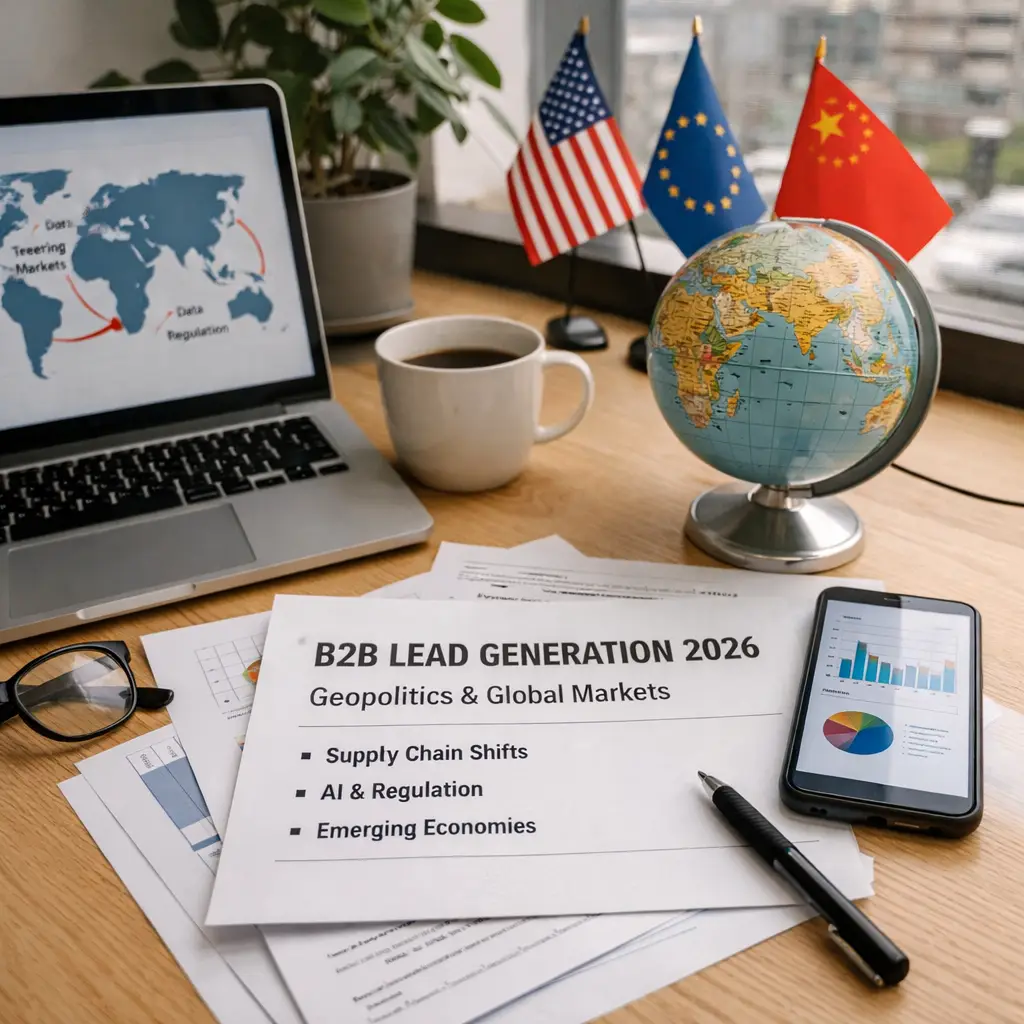
B2B Lead Generation in 2026: How Geopolitical Shifts Are Reshaping Global Markets
B2B lead generation in 2026 is no longer driven solely by marketing technology, automation, or data. It is increasingly shaped by global geopolitical forces—from trade realignments and regional conflicts to data sovereignty laws and supply chain restructuring.
As businesses operate in a more fragmented, multipolar world, traditional lead generation models are under pressure. Buyers are cautious, budgets are scrutinized, and decision-making cycles are longer. At the same time, new markets, emerging economies, and digital channels are opening unprecedented growth opportunities.
This blog explores how geopolitical changes are transforming B2B lead generation in 2026 and what businesses must do to stay competitive.
- The Global Shift to a Multipolar Market Economy
For decades, B2B growth strategies focused primarily on North America and Western Europe. In 2026, this approach is outdated.
What’s changed?
- Economic power is now distributed across multiple regions: India, Southeast Asia, the Middle East, Africa, and Latin America.
- Regional trade blocs and local manufacturing incentives are influencing buying decisions.
- Businesses prefer local or regionally aligned partners to reduce geopolitical risk.
Impact on B2B Lead Generation
- Ideal Customer Profiles (ICPs) must be region-specific, not global templates.
- Messaging needs cultural, regulatory, and economic localization.
- Lead sources are shifting from global platforms to regional ecosystems and partnerships.
Key takeaway: One-size-fits-all lead generation no longer works in 2026.
- From Lead Generation to Demand Generation
B2B buyers today complete most of their research before engaging with sales. This trend has accelerated due to economic uncertainty and geopolitical instability.
Why traditional lead gen is declining
- Gated content and aggressive outbound outreach generate volume, not intent.
- Buyers distrust overly promotional messaging.
- Decision committees are larger and more risk-averse.
What replaces it in 2026
- Demand generation focused on education, authority, and trust.
- Ungated thought leadership, industry insights, and problem-first content.
- Visibility across AI search tools, communities, and peer networks.
Winning brands in 2026 don’t chase leads — they shape demand early.
- How Geopolitical Tensions Are Changing Buyer Behavior
Geopolitical uncertainty directly affects how B2B buyers evaluate vendors.
Common buyer concerns in 2026
- Supply chain resilience
- Data security and compliance
- Long-term vendor stability
- Regional legal and regulatory risks
What buyers expect from vendors
- Transparency in operations and data handling
- Clear regional presence or partnerships
- Demonstrated understanding of local markets
Lead generation implication
Your content must address risk, stability, and continuity, not just features and pricing.
- AI, Regulation, and the New Rules of Visibility
AI adoption is accelerating globally, but regulation is fragmenting.
Key developments affecting B2B marketing
- Data residency and sovereignty laws
- AI governance frameworks
- Cross-border data transfer restrictions
What this means for lead generation
- CRM and marketing automation must comply with local laws.
- Content distribution strategies must adapt to regional platforms.
- SEO is evolving into Answer Engine Optimization (AEO) and Generative Engine Optimization (GEO) to stay visible in AI-driven search.
In 2026, visibility depends as much on compliance as creativity.
- Supply Chain Realignment Creates New B2B Opportunities
Geopolitical shocks have forced organizations to rethink supply chains.
Market shifts
- Near-shoring and friend-shoring strategies
- Diversification of vendors
- Increased demand for risk intelligence and operational transparency
Opportunity for B2B companies
- Position your solutions as risk-mitigation enablers
- Create lead magnets focused on resilience, continuity, and optimization
- Use case studies tied to real-world disruptions
This approach attracts high-intent, problem-aware buyers.
- Winning B2B Lead Generation Strategies for 2026
To succeed in this new environment, B2B marketers must evolve.
Strategic priorities
- Region-first GTM strategies
- Thought leadership over transactional content
- Trust-based messaging aligned with geopolitical realities
Tactical execution
- Localized content hubs for priority regions
- Executive-level insights and industry commentary
- Strong alignment between marketing, sales, and compliance teams
Metrics that matter
- Pipeline influence, not just MQLs
- Engagement depth and return visits
- Sales-accepted opportunities by region
Conclusion: Lead Generation Is Now a Strategic Function
In 2026, B2B lead generation is no longer just a marketing activity—it is a strategic business function influenced by global politics, economics, and regulation.
Companies that succeed will be those that:
- Understand regional market dynamics
- Invest in long-term demand generation
- Build trust through transparency and expertise
- Adapt quickly to geopolitical and regulatory change
The future belongs to B2B brands that move beyond volume-driven tactics and focus on relevance, resilience, and relationships.
Looking to future-proof your B2B lead generation strategy for 2026?
Get in touch with our experts to build a region-ready, demand-driven growth engine.

20 Responses
Hello, I log on to your blog on a regular basis. Your story-telling style is awesome, keep it up!
great content
keep posting more on current geological shift.
Как настроить VPN на MacOS без сторонних приложений?
Да, на macOS можно настроить VPN без сторонних приложений — через встроенные системные настройки. Но для этого тебе всё равно нужны данные VPN-сервера (адрес, тип протокола, логин/пароль или сертификат), которые обычно предоставляет компания или VPN-провайдер.
Worth reading
Влияет ли использование VPN на индексацию сайта в поисковиках?
Using a VPN generally does not directly affect a website’s indexing in search engines
Маркетинговое агентство — в каких случаях лучше нанять штатного маркетолога?
The right time to hire an in-house marketer is when you clearly understand your target audience, your product positioning, and your go-to-market approach.
Many companies make the mistake of investing heavily in marketing too early without properly understanding:
* Who their ideal customers are
* Which channels actually work for their audience
* What messaging creates engagement and conversions
Because of this, they often:
* Spend budget on irrelevant prospects
* Apply the wrong strategies and execution methods
* Expect instant sales results from marketing activities
One of the biggest misconceptions is treating marketing as a direct sales function. Marketing’s role is to build awareness, create demand, and generate a qualified sales pipeline. It usually starts slowly, builds consistency over time, and supports long-term growth rather than immediate revenue alone.
Hiring an in-house marketer makes more sense when:
* You already have a validated product/service
* Your customer journey is more defined
* You need consistent brand messaging and long-term campaigns
* You have enough marketing workload to justify a dedicated resource
* Your sales process and CRM structure are already established
* You want tighter collaboration between sales and marketing teams
Until then, many businesses benefit more from agencies or external partners because they bring broader experience, tested strategies, and flexibility without the overhead of a full-time hire.
Practical takeaways shared
Practical takeaways shared
Продвижение сайта с гарантией — что именно гарантируется: позиции, трафик или лиды?
Влияет ли возраст домена на продвижение молодых сайтов?
Yes
This was very helpful.
Thought-provoking!
Wonderful article!
Informative article!
Great read!