

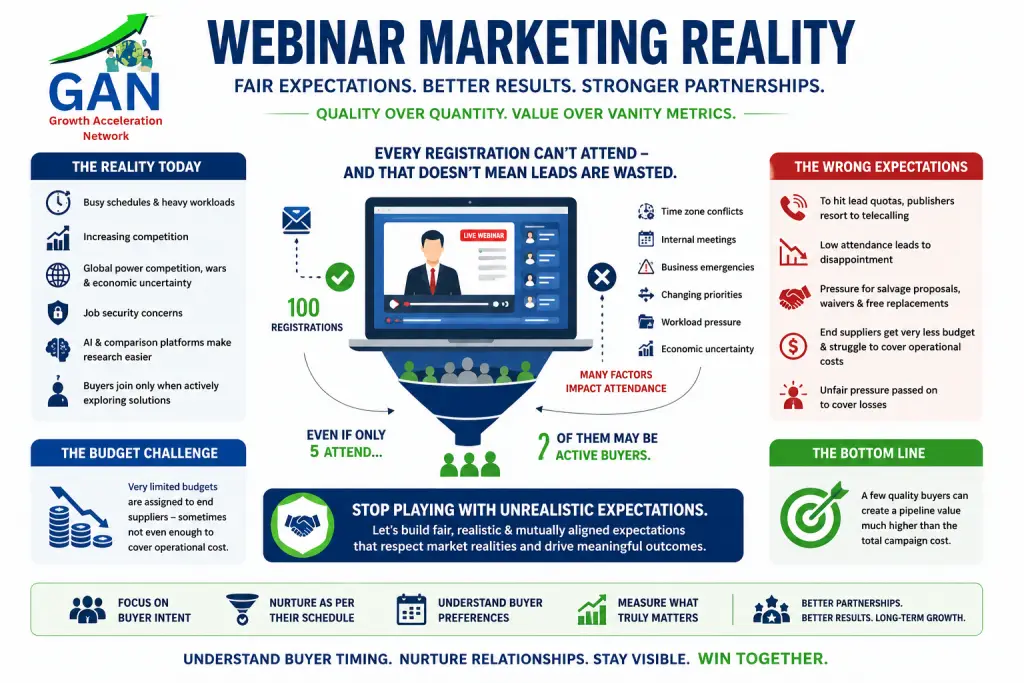
In today’s B2B marketing environment, webinars continue to be one of the most widely used strategies for lead generation and brand engagement. However, there is a growing disconnect between real market behavior and the expectations often set around webinar attendance numbers.
Many media houses and marketing intermediaries continue to promote unrealistic expectations regarding registrations, attendance ratios, and campaign outcomes — without fully acknowledging the challenges businesses and audiences face in today’s global working environment.
The Reality of Webinar Registrations
Driving webinar registrations through email marketing is no longer as simple as it was a few years ago. Today’s professionals operate under:
- Heavy workloads and tighter deadlines
- Increased market competition
- Global economic uncertainty
- Ongoing geopolitical tensions and wars
- Growing concerns around job security
- Information overload from multiple digital platforms
Because of this, many decision-makers may register for a webinar but fail to attend due to schedule conflicts, changing priorities, or internal business pressures.
Attendance should therefore not be viewed as the only measurement of campaign success.
Buyers Today Research Differently
The rise of AI-powered search tools, software comparison platforms, online reviews, and automated recommendation engines has changed buyer behavior significantly.
Today, potential buyers can quickly compare vendors, pricing, features, and customer feedback without immediately engaging with a sales team or attending a webinar.
This means many prospects may only join webinars when they are actively evaluating solutions or entering a purchasing cycle. Others may consume the information later through recordings, follow-up emails, or additional nurturing campaigns.
The Pressure on Lead Generation Partners
To meet aggressive lead quotas promised to clients, some publishers and intermediaries increasingly rely on telecalling and additional manual outreach efforts to boost registration numbers.
However, when attendance ratios fall below expectations, end suppliers are often pressured into offering:
- Salvage proposals
- Free replacement leads
- Waivers or discounted extensions
- Additional unpaid services
This has become a common industry practice that shifts operational and financial pressure onto delivery partners while allowing intermediaries to protect profit margins.
The Operational Cost Challenge
In many campaigns, the actual budget allocated to the end supplier is extremely limited. In some cases, it may not even fully cover:
- Operational expenses
- Resource allocation
- Outreach costs
- Follow-up efforts
- Technology and delivery management
Despite this, suppliers are still expected to deliver high attendance ratios under increasingly difficult market conditions.
Why Low Attendance Does Not Mean Poor Leads
One of the biggest misconceptions in webinar marketing is assuming that low attendance automatically means campaign failure.
For example:
- Out of 100 registrations, even if only 5 attendees join live,
- 2 of those attendees may be active buyers with immediate purchasing intent.
In many B2B environments, the value of a few qualified buyers can generate a sales pipeline far greater than the total marketing investment spent on the campaign.
Quality matters more than vanity metrics.
The Need for Fair and Realistic Expectations
The industry must move toward more realistic and transparent campaign expectations that align with actual buyer behavior and modern marketing standards.
Not every registered prospect will attend a webinar live — and that does not make the lead wasted.
There are many factors that impact attendance:
- Time zone conflicts
- Internal meetings
- Business emergencies
- Changing priorities
- Workload pressure
- Economic uncertainty
Successful marketing is not about forcing prospects to match a seller’s calendar. It is about understanding buyer timing, nurturing relationships, and remaining visible until the prospect is ready to engage.
Final Thoughts
Webinar campaigns should be measured through:
- Buyer intent
- Pipeline contribution
- Engagement quality
- Long-term nurturing value
- Brand positioning
—not just attendance percentages.
The market has changed, buyer behavior has evolved, and marketing expectations must evolve with it.
Instead of chasing unrealistic numbers, businesses, publishers, and intermediaries should focus on creating fair partnerships, sustainable delivery models, and outcome-driven marketing strategies that respect both buyers and delivery teams.

One Response
Great said.