

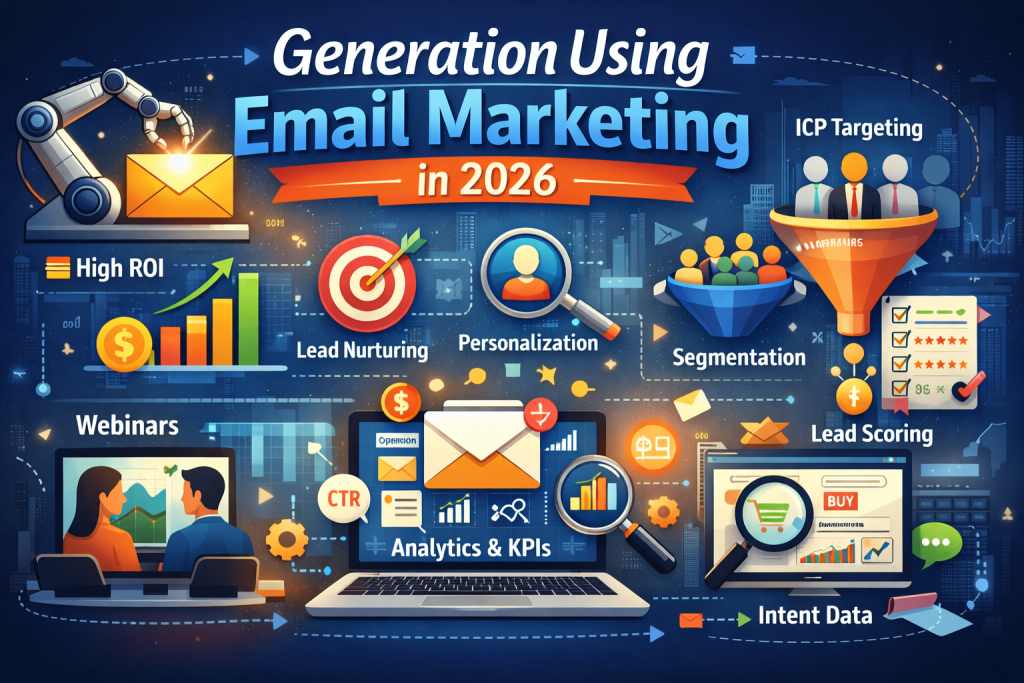
In today’s competitive B2B landscape, generating high-quality leads is no longer about volume — it’s about precision, personalization, and nurturing. While channels like paid ads and social media play a role, email marketing remains the highest ROI channel for B2B lead generation.
According to multiple industry studies, email marketing consistently delivers stronger engagement and conversion rates compared to social media and display ads.
Let’s explore how to build a powerful B2B lead generation engine using email marketing.
Why Email Marketing Still Dominates B2B Lead Generation
Unlike B2C, B2B buying cycles are longer and involve multiple decision-makers. Email helps you:
- Nurture prospects over time
- Educate decision-makers
- Personalize messaging by industry or job role
- Track engagement signals (opens, clicks, downloads)
- Move Marketing Qualified Leads (MQLs) to Sales Qualified Leads (SQLs)
Email isn’t just about promotions — it’s about building trust and authority.
Step 1: Define Your Ideal Customer Profile (ICP)
Before sending emails, clearly define:
- Target industries
- Company size
- Geography
- Decision-maker titles (CMO, CIO, Head of Marketing, etc.)
- Revenue bracket
Without clear targeting, email campaigns fail — not because email doesn’t work, but because the audience isn’t aligned.
Step 2: Build a High-Quality B2B Email List
There are three effective methods:
- Content Syndication
Offer whitepapers, case studies, or reports to capture intent-driven leads.
- Gated Content
Create high-value resources that require form submission.
- Webinar Registrations
Webinars are powerful for generating high-intent prospects.
Using tools like HubSpot or Mailchimp helps automate list building and segmentation.
Step 3: Segment for Better Conversions
Segmentation improves engagement dramatically. Segment based on:
- Industry
- Job function
- Funnel stage
- Engagement level
- Company size
For example:
- CFOs respond better to ROI-focused messaging.
- Marketing leaders respond better to growth and pipeline metrics.
Step 4: Craft High-Converting B2B Email Campaigns
Your B2B email should include:
✅ Strong Subject Line
Keep it clear and benefit-driven.
✅ Personalized Opening
Use first name, company name, or industry context.
✅ Value-Driven Body
Focus on solving business challenges — not selling features.
✅ Clear CTA
Examples:
- Download the whitepaper
- Book a consultation
- Register for the webinar
Step 5: Use Lead Scoring to Identify Sales-Ready Prospects
Not every lead is ready to buy immediately.
Assign scores based on:
- Email opens
- Link clicks
- Content downloads
- Website visits
When engagement crosses a threshold, move them from MQL to SQL and hand them to sales.
Marketing automation tools like Marketo and Salesforce can automate this process.
Step 6: Automate Lead Nurturing Workflows
Create automated email sequences such as:
- Welcome series
- Educational content series
- Case study sequence
- Webinar follow-up
- Re-engagement campaigns
Automation ensures consistent communication without manual effort.
Step 7: Track KPIs That Matter
Measure:
- Open Rate
- Click-Through Rate (CTR)
- Conversion Rate
- Cost per Lead (CPL)
- SQL Rate
- Revenue Influence
Avoid vanity metrics — focus on pipeline contribution.
Common Mistakes in B2B Email Lead Generation
❌ Buying random email lists
❌ Sending generic, non-personalized emails
❌ No segmentation
❌ No follow-up strategy
❌ Ignoring mobile optimization
Bonus Strategy: Combine Email with Intent Data
Intent-based email marketing dramatically increases conversions. When prospects show buying signals (content consumption, competitor research), trigger personalized outreach immediately.
Final Thoughts
B2B lead generation through email marketing is not dead — it’s evolving.
The businesses that win are those who:
- Target precisely
- Personalize intelligently
- Automate strategically
- Nurture consistently
If implemented correctly, email marketing can become your highest ROI B2B channel — driving predictable pipeline growth and measurable revenue.

One Response
Email still drives B2B growth—when done with precision, not volume.