

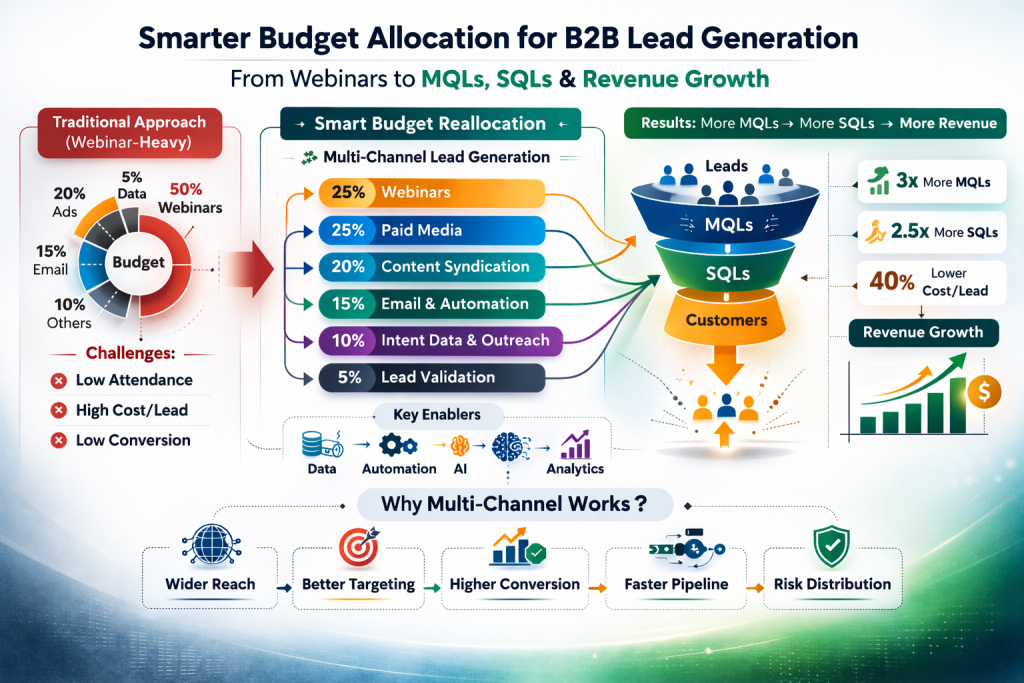
In today’s competitive B2B landscape, marketing leaders are under constant pressure to do more with less. Budgets are scrutinized, ROI expectations are rising, and traditional lead generation methods—like heavy reliance on webinars—are no longer delivering consistent results.
Forward-thinking organizations are now shifting toward smarter budget allocation strategies that prioritize measurable outcomes such as Marketing Qualified Leads (MQLs), Sales Qualified Leads (SQLs), and ultimately, revenue.
The Problem with Over-Reliance on Webinars
Webinars have long been a go-to channel for B2B lead generation. While they still hold value, many companies face challenges such as:
- Declining attendance rates
- Low engagement during sessions
- High cost per lead
- Poor conversion from attendee to opportunity
In many cases, a significant portion of the marketing budget gets locked into webinars without delivering proportional pipeline impact.
The Shift: From Activity-Based to Outcome-Based Budgeting
Modern B2B teams are moving away from activity-based planning (e.g., “run 10 webinars this quarter”) to outcome-based strategies focused on:
- Cost per MQL
- Cost per SQL
- Pipeline contribution
- Revenue attribution
This shift enables businesses to allocate budgets where they see real returns—not just where they’ve traditionally invested.
Diversifying Lead Generation Channels
Instead of relying on a single channel, successful companies are building multi-stream lead generation engines. Key channels include:
- Intent-Based Data & Targeted Outreach
Using intent signals and enriched data, businesses can target prospects actively researching solutions. This increases the likelihood of generating high-quality MQLs.
- Content Syndication
Distributing gated content across trusted platforms helps reach new audiences and drive consistent lead flow at scale.
- Paid Media (Performance Marketing)
Platforms like LinkedIn and Google Ads allow precise targeting, helping convert prospects into MQLs and SQLs more efficiently.
- Email Nurturing & Marketing Automation
Automated workflows ensure that leads are continuously nurtured, improving conversion rates from MQL to SQL.
- Partner & Affiliate Channels
Collaborating with partners expands reach and brings in leads that are often closer to decision-making stages.
Budget Reallocation Strategy: A Practical Approach
A common trend among high-performing teams is reallocating budgets from webinars into diversified channels. For example:
- Reduce webinar spend from 50% → 20–25%
- Allocate savings into:
- Performance marketing campaigns
- Data-driven outreach programs
- Content syndication
- Lead validation and enrichment
This approach ensures a steady flow of leads across the funnel rather than spikes tied to single events.
Focusing on MQLs vs. SQLs: Quality Over Quantity
Generating leads is no longer enough. The focus must shift to:
- MQLs: Leads that meet predefined marketing criteria
- SQLs: Leads validated by sales as high-intent opportunities
Smart budget allocation prioritizes channels that deliver higher SQL conversion rates—not just volume. This reduces wasted spend and improves sales efficiency.
The Role of Lead Validation & Data Quality
One critical yet often overlooked factor is lead quality. Investing in lead validation systems ensures:
- Accurate contact data
- Reduced duplicates
- Higher connect rates for sales teams
Better data directly impacts conversion rates and ROI.
Driving Revenue Through Multi-Channel Strategy
Organizations adopting a multi-channel approach report:
- Higher pipeline consistency
- Improved lead-to-opportunity conversion
- Better alignment between marketing and sales
- Increased overall ROI
By spreading investments across multiple streams, businesses reduce risk and unlock scalable growth.
Key Takeaways
- Webinars should be part of the mix—not the entire strategy
- Shift focus from activities to measurable outcomes like MQLs and SQLs
- Diversify channels to build a resilient lead generation engine
- Invest in data quality and lead validation
- Align budget allocation with revenue impact, not tradition
Final Thoughts
Smarter budget allocation is no longer optional—it’s essential for sustainable B2B growth. Companies that move beyond single-channel dependency and embrace a diversified, data-driven approach will not only generate better leads but also drive meaningful revenue outcomes.
The future of B2B lead generation lies in precision, flexibility, and continuous optimization.

One Response
Smarter B2B growth comes from shifting budgets to measurable outcomes—MQLs, SQLs, and multi-channel impact, not just webinars.