

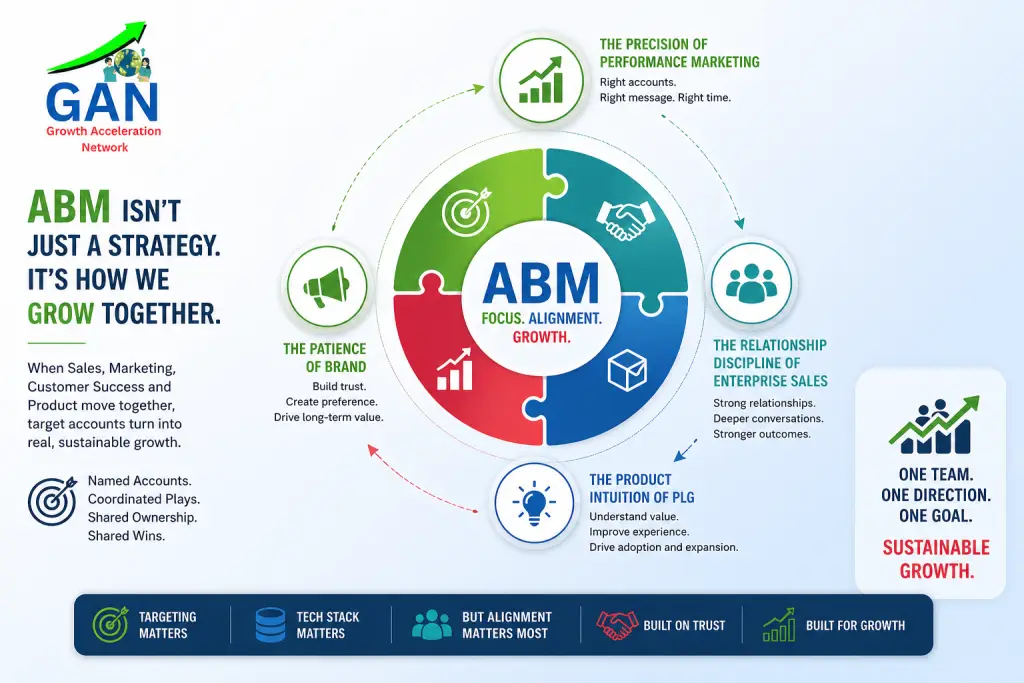
Account-Based Marketing Isn’t What You Think It Is
ABM (Account-Based Marketing) might be one of the most misunderstood acronyms in modern marketing—not because people don’t know the term, but because they misunderstand what it’s actually made of.
Most treat ABM as a separate strategy, a standalone playbook, or just another campaign type.
It’s not.
ABM isn’t a new discipline.
It’s a composition of the best parts of what already works.
What ABM Is Really Made Of
At its core, ABM brings together multiple strengths:
- The precision of performance marketing — targeting the right accounts with intent and accuracy
- The patience of brand building — creating long-term trust, not just short-term wins
- The relationship discipline of enterprise sales — nurturing key stakeholders over time
- The product intuition of product-led growth (PLG) — understanding how value is experienced, not just sold
When you strip away the acronym, what remains is simple:
Marketing done with more focus, more coordination, and more shared ownership.
Where ABM Actually Becomes Powerful
The difference with ABM isn’t just who you target—
it’s how your entire organization aligns around those accounts.
- The accounts are clearly defined
- The messaging is coordinated
- The outreach is intentional
- The experience is consistent
And most importantly:
The win only counts when Sales, Marketing, Customer Success, and Product move together.
That’s the real shift.
The Most Overlooked Ingredient: Shared Ownership
Many teams focus heavily on:
- Target account lists
- Data enrichment
- Martech stacks
- Campaign execution
All of that matters.
But none of it works without alignment.
Shared ownership is what makes ABM actually effective.
It’s what turns a list of high-value accounts into a real, scalable growth engine.
Because:
- Marketing can open doors
- Sales can build relationships
- Product can deliver value
- Customer Success can expand accounts
But only together can they drive sustained growth.
You Can Build Tools. Alignment Takes Time.
You can invest in:
- Better data
- Smarter platforms
- More automation
Those are relatively easy.
What’s harder—and far more valuable—is building:
- Trust between teams
- Clear communication loops
- Shared goals and accountability
Alignment isn’t a tool you buy.
It’s something you build over time.
When ABM Stops Being a Campaign
The real transformation happens when ABM no longer feels like a campaign or a tactic.
It becomes:
The way your company goes to market.
At that point:
- Sales and marketing don’t operate in silos
- Product decisions reflect real customer insights
- Customer success becomes a growth driver, not just support
- Every touchpoint feels connected
And growth stops being fragmented—it becomes intentional and repeatable.
Final Thought
ABM isn’t about adopting a new framework.
It’s about operating differently.
The teams that succeed with ABM aren’t the ones with the best tools or the biggest budgets.
They’re the ones that invest in alignment, build cross-functional muscle, and commit to moving together.
Because in the end:
ABM doesn’t change marketing.
It changes how the entire business grows.